
- How to make a smoothie for cancer patients | Simple, nutritious, and tolerable nutrition during treatment
- What are the characteristics of a good smoothie for a cancer patient?
- Real Experiences from Families
- Important principles before preparing a smoothie for a cancer patient
- The best ingredients for a smoothie for cancer patients
- How to prepare some smoothies suitable for cancer patients
- What smoothies are not suitable for cancer patients?
- The Empathy Foundation’s View of Patient Nutrition
- Advanced Tips for Increasing the Nutritional Value of Smoothies for Cancer Patients
- How to Boost a Smoothie Without Making It Heavy?
- Low appetite; the main problem that smoothies solve
- Important tips to reduce nausea when consuming smoothies
- The Psychological Role of Nutrition in Cancer Patients
- A real experience from families
- How to make smoothies part of your daily routine?
- Summary
- Frequently Asked Questions About How to Make Smoothies for Cancer Patients
- Scientific and specialized resources
How to make a smoothie for cancer patients | Simple, nutritious, and tolerable nutrition during treatment
Introduction
When cancer strikes a family, many things change; from the atmosphere at home to the simplest food choices. One of the serious challenges during chemotherapy or radiotherapy is loss of appetite, nausea, and difficulty swallowing food. This is where smoothies become a real lifesaver.
Smoothies are not just a delicious drink; if prepared correctly and purposefully, they can provide some of the energy, vitamins, and minerals the body needs without putting pressure on the stomach and are among the best drinks for cancer patients, such as tonics.
In this article, we will talk step by step about how to prepare a suitable smoothie for cancer patients; from a scientific, experimental, and completely practical perspective.
What are the characteristics of a good smoothie for a cancer patient?
Not every smoothie is suitable for this condition. The body is more sensitive than usual during treatment.
A good smoothie should have these characteristics:
Easy to digest and light
Contain natural and controlled sugars
Do not cause stomach irritation or nausea
Contain sufficient protein and energy
Be compatible with oral conditions (sores or dryness)
The important point here is: the goal is not to “treat cancer with food”; the goal is to help the body better tolerate treatment and maintain energy.
Real Experiences from Families
In our conversations with families supported by the Empathy Foundation, one point was repeated many times:
On days when a patient cannot even eat a bite of food, a simple glass of smoothie is sometimes all his body can tolerate.
One mother explained:
“When my son wouldn’t eat anything after chemotherapy, I would just make him a banana and milk smoothie. He would eat easily and get some energy.”
These experiences show that nutrition during this period is not just science; it is part of daily care and love.
Important principles before preparing a smoothie for a cancer patient
Before any recipe, there are a few crucial points to consider:
1. Consult a doctor or nutritionist
Some patients have special diets, especially if they have a weakened immune system.
2. Maintain good hygiene
Fruits should be thoroughly washed and fresh ingredients used.
3. Avoid heavy additives
such as high sugar, heavy cream, or processed ingredients.
4. Consider the patient’s condition
If they are nauseous, use mild flavors. If they are severely weak, increase the calories in the smoothie.
The best ingredients for a smoothie for cancer patients
Suitable fruits:
Banana (energizing and mild)
Apple (helps with digestion)
Mango (high in calories and delicious)
Blueberries (high in antioxidants)
Pear (light and digestible)
Base liquids:
Low-fat or lactose-free milk
Almond milk or oat milk
Natural coconut water
Useful additives:
Natural peanut butter (in small amounts)
Natural honey (if allowed)
Chia seeds or flax seeds
Probiotic yogurt
How to prepare some smoothies suitable for cancer patients
1. Banana and Peanut Butter Smoothie (Energetic)
Ingredients:
1 ripe banana
1 tablespoon natural peanut butter
1 glass almond milk
1 tablespoon honey (optional)
Preparation method:
Pour all ingredients into a blender until completely smooth. This smoothie is very suitable for days when the patient is very weak.
2. Apple and Cinnamon Smoothie (Mild and soothing)
Ingredients:
1 apple
Half a glass of yogurt
A very small amount of cinnamon
A little honey
This combination is suitable for when the patient’s stomach is sensitive and needs a light meal.
3. Antioxidant Smoothie (Blueberry and Banana)
Ingredients:
Half a cup of blueberries
1 banana
1 cup of low-fat milk
Chia seeds
This smoothie helps to support the body in general due to the presence of antioxidants.
4. Strengthening Smoothie (for weight loss and severe weakness)
Ingredients:
Banana
Oatmeal
Milk
Peanut butter
A little honey
This combination is high in calories and is suitable for patients in a period of severe weakness.
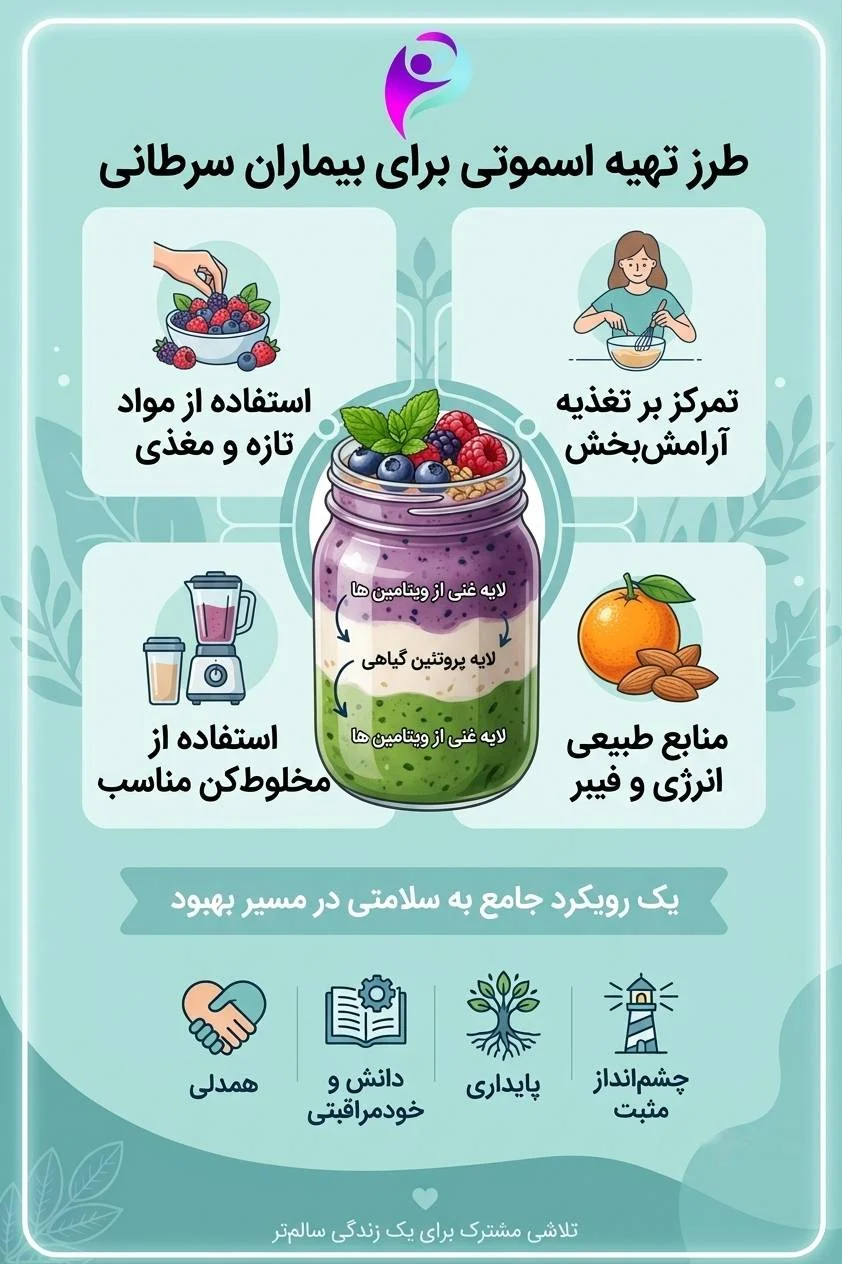
What smoothies are not suitable for cancer patients?
Very sweet smoothies with added sugar
Very acidic ingredients such as too much orange or too much lemon
Very cold drinks when nauseated
Unknown ingredients or medicinal herbs without a doctor’s advice
The role of smoothies in improving the patient’s quality of life
A smoothie is not supposed to work miracles, but it can help the body not “completely empty” during the most difficult days. This simple matter has an indirect effect on energy, mood, and even the treatment process.
When a patient can eat something without difficulty, they are one step away from weakness.
Common mistakes in preparing smoothies for cancer patients
Excessive use of sugar
Ignoring the patient’s oral and stomach conditions
Heavy and indigestible ingredients
Use of preservatives or industrial ingredients
Ignoring the doctor’s opinion
The Empathy Foundation’s View of Patient Nutrition
At the Empathy Foundation, experience has shown that help is not just about money. Sometimes a glass of smoothie made with awareness can be as valuable as financial support.
Our goal is for families to learn how to improve the patient’s quality of life alongside treatment.
Advanced Tips for Increasing the Nutritional Value of Smoothies for Cancer Patients
When the disease enters the treatment phase, the body doesn’t just need to “eat”; it needs targeted nutrition. This is where a smoothie can go from being a simple drink to a real support tool for the body.
To be more specific, a smoothie is most effective when it covers three goals at once: energy, repair, and digestive tolerability.
How to Boost a Smoothie Without Making It Heavy?
A common mistake is to think that the more ingredients, the better the smoothie. When it comes to a cancer patient’s body, they need balance, not a rush of ingredients.
1. Add protein in moderation
Protein is important for tissue repair, but it should be used sparingly:
Low-fat Greek yogurt
Protein powder under the supervision of a doctor
Fortified milks
For example, adding two to three tablespoons of Greek yogurt to a banana smoothie will both soften the texture and increase the nutritional value without weighing you down.
2. Eat healthy fats (in moderation)
Healthy fats are essential for long-lasting energy, especially when you have a poor appetite.
Good sources:
Natural peanut butter
Avocado
Flax or chia seeds
The important thing to remember is that too much fat, even if it’s healthy, can make you nauseous. Balance is key here.
3. Increase nutrient absorption with smart blending
Some food combinations are better absorbed when combined.
For example:
The vitamin C in fruits helps improve the absorption of certain antioxidants
Combining fruit with healthy fat improves the absorption of fat-soluble vitamins
This means that a smoothie is not just a blend, it is a mini nutritional design.
Low appetite; the main problem that smoothies solve
In many patients, the main problem is “lack of appetite” and not lack of food.
In this situation, smoothies have an important advantage:
They do not require chewing
Small volume, high energy
Can be consumed quickly
They have less odor than hot foods (important for reducing nausea)
It has been seen in the experience of families that even on days when the patient is avoiding food, the smoothie is more easily accepted because his mind does not consider it “food” but rather sees it as a light drink.
Important tips to reduce nausea when consuming smoothies
Nausea is a serious challenge during treatment. To ensure that smoothies do not aggravate this condition, there are a few simple but important tips:
The smoothie should not be too cold
Avoid flavors that are too sweet or too spicy
The volume consumed should be small and in several stages
After consumption, the patient should be in a sitting or semi-sitting position
Sometimes even a simple change in the temperature of the drink can make a big difference in its acceptance.
The Psychological Role of Nutrition in Cancer Patients
Nutrition is not just a physical issue; it also has a direct impact on the mood.
When a patient can eat something without difficulty, they feel more in control of their own body. This small but important feeling is invaluable during the days when treatment is difficult and exhausting.
In many families, making a smoothie has become a quiet moment of the day; a moment when the patient and family are together and do a simple but caring thing.
A real experience from families
One of the companions of the Hamdali Foundation explained:
“After a few chemotherapy sessions, my mother had difficulty even drinking water. We started making smoothies for her every day. At first, she ate little, but gradually she asked for it herself.”
These experiences show that nutrition in this path is not just “science”; it is a kind of human companionship that has an indirect but real effect on the treatment process.
How to make smoothies part of your daily routine?
If you want smoothies to be truly helpful, they should be consumed regularly, not sporadically.
A few simple suggestions:
Dedicate a light morning or evening meal to smoothies
Change the ingredients every few days to avoid repetition
Involve the patient in choosing the flavors
Replace large, scattered amounts with small, consistent amounts
Summary
Smoothies are a simple but important way for cancer patients to maintain energy levels. The right combination of fruits, fluids, and nutrients can help patients get through their treatment more easily.
It may sound simple, but in practice, it has become a daily lifeline for many families.
Frequently Asked Questions About How to Make Smoothies for Cancer Patients
Can a smoothie replace a meal?
No. A smoothie is only a nutritional supplement, not a complete meal replacement.
When is the best time to drink a smoothie for a cancer patient?
When the patient has no appetite or between meals.
Can supplements be used in a smoothie?
Only with a doctor’s prescription.
Is a cold smoothie suitable for the patient?
If there is nausea, it is better not to drink it too cold.
Scientific and specialized resources
- American Cancer Society – Nutrition for Cancer Patients
- World Health Organization (WHO) – Cancer care guidelines
- National Cancer Institute – Eating Hints for Cancer Patients
The author of the article:Erfan

