
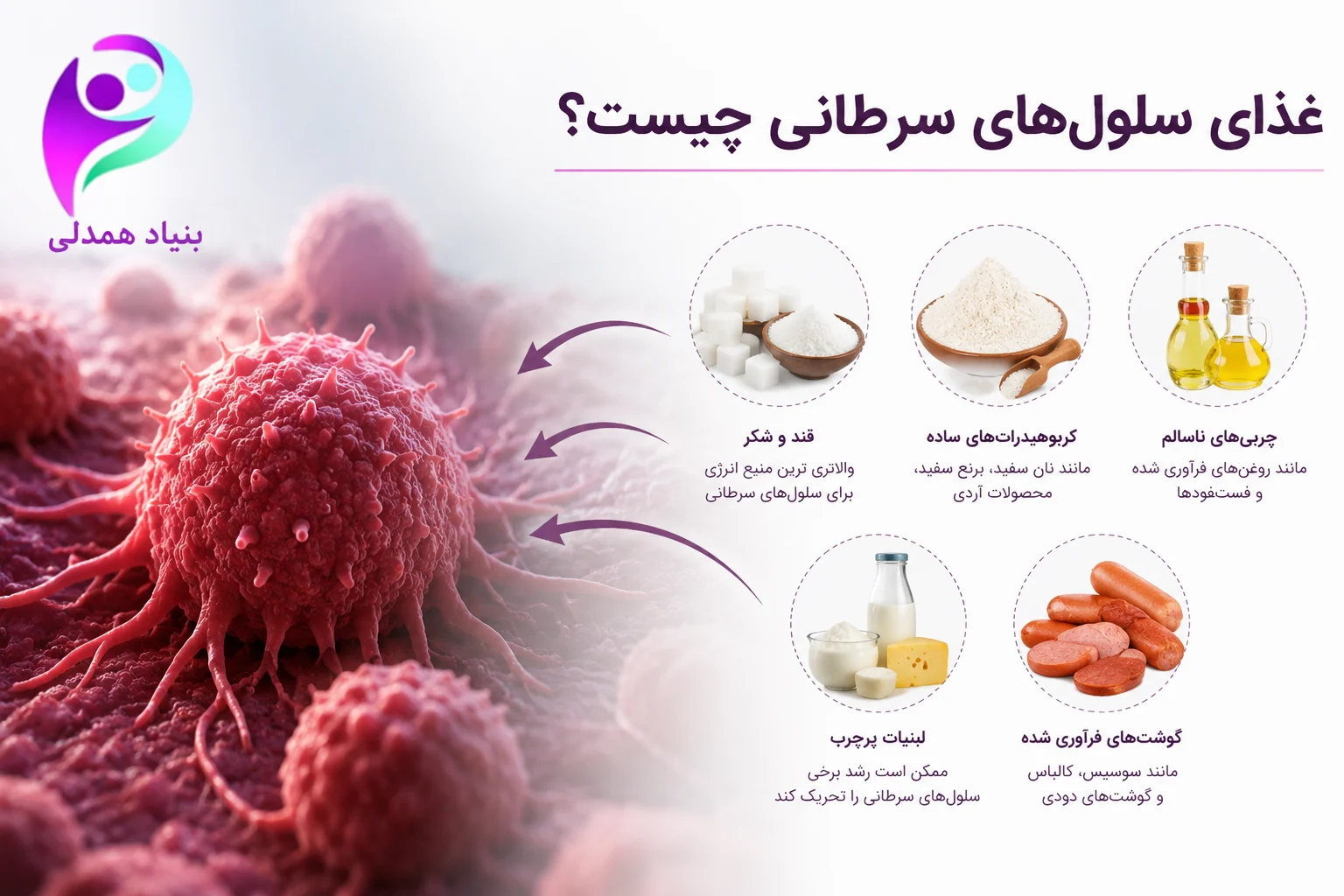
What is the food of cancer cells? A realistic, scientific, and understandable look at what fuels tumors
If someone in your family has cancer or you are involved in caring for someone, this question has probably come to you very soon:
“What are the foods of cancer cells? What exactly makes them grow?”
Let me put it very simply:
Cancer cells are like uninvited guests; they will not stop growing until they get the right food and conditions. But contrary to rumors, there is no specific food that we can say “this creates cancer”. The issue is more complicated and of course more important than this.
The Hamdali Foundation Charity is a support group in the field of helping cancer patients, which aims to reduce treatment concerns, cover essential expenses and boost the morale of patients. This foundation, with public donations and the participation of donors, tries to make the treatment path smoother for patients and their families. If you are interested in supporting, you can do so through online payment, telephone contact or online chat. Also, people who need help or advice can easily contact the foundation’s support team through these communication channels to receive the necessary guidance.
- Why do we say that cancer cells have “food”?
- The most important fuel for cancer cells: sugar
- Unhealthy fats: a hidden helper for cancer
- Processed proteins: dangerous fuel
- Hyper-inflammatory foods: the silent enemy
- Why do they say white sugar is worse for cancer than fruit?
- The role of IGF-1; the hormone that tells cancer cells to “work harder”
- Foods that cause inflammation also promote cancer cells.
- So what food weakens cancer?
- Is it really possible to “starve cancer”?
- The best thing to do to control the “fuel” of cancer
- A simple example of a low-carb day for cancer
- Do all people “fuel” cancer to the same extent?
- Why do some foods behave “duplicitously”?
- Why do they say cancer cells like an acidic environment?
- The role of stress in fueling cancer
- Supplements that may unintentionally feed cancer cells
- Does fasting starve cancer cells?
- A brief list of foods that cancer cells love the most
- A Real Look at What “Feeds Cancer”
- Simple conclusion
- Frequently Asked Questions About Cancer Cell Food
Why do we say that cancer cells have “food”?
The body’s cells need energy to survive. This energy usually comes from three sources:
- Glucose
- Fat
- Protein
Cancer cells use the same sources; there’s just one big difference:
They consume fuel more greedily.
That is, if two normal cells are next to each other and a cancer cell is between them, that cancer cell will usually grab more food so it can multiply better and faster.
Simply put:
It’s not about “food,” it’s about the behavior of the cell.
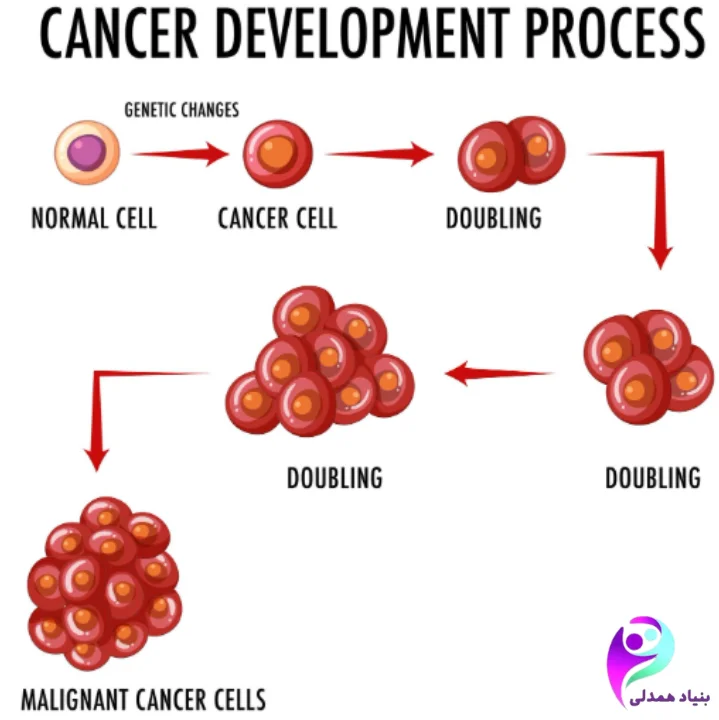
The most important fuel for cancer cells: sugar
All cells in the body use glucose for energy; even the brain especially loves glucose.
But why do we hear everywhere that “sugar feeds cancer”?
Because cancer cells use an old and inefficient pathway called “glycolysis.”
This method doesn’t produce much energy, so the cell is forced to consume more sugar to cover its needs. The result?
- The higher the blood sugar,
- the more food is available for cancer cells to grow.
But let me make the important point here, to put your mind at ease:
Sugar does not directly cause cancer.
But once cancer is present,
excess sugar can speed up its growth.
For example:
- Soft drinks
- Candy
- Cakes
- White sugar
- Energy drinks
- Fizzy drinks
These are the best “instant fuel” for cancer cells.
Unhealthy fats: a hidden helper for cancer
Imagine they’re going to build a building. If there’s a lot of concrete, it’s easier to build new floors.
In the body, fats work the same way. Cancer cells need fats to build their membranes and protective layers around them, especially:
- Trans fats (like fast food, processed sweets, solid oils)
- Excessive saturated fats (some sausages, hot dogs, deep-fried foods)
These fats help the body increase inflammation, and inflammation is a more favorable environment for cancer.
Processed proteins: dangerous fuel
Here’s where things get a little more serious.
Proteins aren’t inherently bad; in fact, the body needs healthy protein.
The problem is with processed proteins, like:
- Hot dogs
- Sausages
- Bacon
- Smoked and cured meats
These foods contain compounds that drive the body toward chronic inflammation, which is the bedrock in which cancer thrives.
Simply put:
These foods are like providing cancer with building blocks.
Hyper-inflammatory foods: the silent enemy
Hot onions, deep-fried foods, foods that simmer in oil for hours…
These may be delicious, but they spark inflammation in the body.
Cancer cells love inflammation because they multiply better in these conditions.
Common examples in our everyday foods:
- Restaurant fries
- Fried chicken
- Crisps
- Reusable oil-based foods
- Heavy fast foods
These make the body’s environment “more conducive” to cancer growth.
Why do they say white sugar is worse for cancer than fruit?
Sometimes a patient asks:
“So I shouldn’t eat fruit? It has sugar!”
The answer is clear:
Fruit has sugar, but it also has fiber, vitamins, and antioxidant compounds.
The body digests fruit more slowly, and glucose enters the bloodstream at a gentle rate.
But a glass of soda or candy suddenly raises blood sugar, and that’s what cancer cells enjoy.
Simply put:
Fruit = whole food
White sugar = empty energy for cancer
The role of IGF-1; the hormone that tells cancer cells to “work harder”
Here’s a scientific fact that’s really helpful to know:
When your body eats a lot of sugar and certain proteins (like high-fat red meat), it releases a hormone called IGF-1.
This hormone sends the message: “It’s time to grow!”
Cancer cells get this message much faster than normal cells.
So a diet high in sugar + unhealthy fat = the perfect environment for tumor growth.
Foods that cause inflammation also promote cancer cells.
Inflammation is a red line.
The more chronic inflammation there is in the body, the more fertile the ground for cancer.
Foods that increase inflammation:
- Fried foods
- Processed sweets
- Smoked meats
- Soft drinks
- Margarine
- Highly salty foods
- Preservative-rich canned foods
These are exactly like providing a “greenhouse” for cancer cells.
So what food weakens cancer?
This is where hope comes in.
The body has amazing tools; we just need to give it the right fuel.
a) Antioxidants
These are like fire extinguishers.
They are found in abundance in:
- Turmeric
- Garlic
- Onions
- Green tea
- Berries
- Dark leafy greens (spinach, kale, lettuce)
b) Anti-inflammatory foods
- Salmon
- Walnuts
- Chia seeds
- Ginger
- Steamed vegetables
c) Fiber
- Fiber helps prevent blood sugar spikes.
- Oats
- Lentils
- Beans
- Fruit with skin
- Raw or undercooked vegetables
D) Gentle diets like the Mediterranean
This eating style has been proven to:
- Control blood sugar
- Reduce inflammation
- Move the body away from a cancer-friendly environment
Is it really possible to “starve cancer”?
You’ve seen a lot of talk on the internet about:
“Starve cancer cells with this diet.”
The truth is that cancer is very adaptable.
When sugar is low, it can turn to fat or amino acids.
But…
you can slow down its growth.
For example:
- Eliminate simple sugars
- Limit processed meats
- Reduce unhealthy fats
These things are like lowering the gas pressure; the car will still move, but it won’t rev.
The best thing to do to control the “fuel” of cancer
If I were to summarize this section very briefly:
Things to reduce:
- Simple sugar
- Soft drinks
- Candy
- Fast food
- Processed meats
- Fried foods
- Trans fats
Things to increase:
- Vegetables
- Whole fruit (not juice)
- Whole grains
- Legumes
- Healthy protein (chicken, fish, eggs, legumes)
- Good fats (olives, walnuts, avocado)
A simple example of a low-carb day for cancer
To make it more concrete, let’s say you’re going to eat healthier on a typical day:
Breakfast:
Oatmeal + a pinch of cinnamon + a few berries
Snack:
A small handful of almonds
Lunch:
Brown rice + grilled chicken + green salad with lemon
Evening:
Green tea + an apple
Dinner:
Lentil soup with vegetables
This plan isn’t fancy, it won’t leave you hungry; but it won’t spike your blood sugar and keep inflammation down.
If the patient is undergoing chemotherapy, the story is a little different.
Some patients have a loss of appetite or severe nausea during treatment.
Here is the most important principle:
The patient must receive enough energy.
So if the patient can only eat toast or the only thing they will accept is a banana, they should not be forced to follow a strict diet.
Cancer nutrition should always be “personalized”.
Do all people “fuel” cancer to the same extent?
No, not at all.
Two people can eat the exact same food, but their bodies can react completely differently. Why? Because there are a few important factors involved:
- Genetics
- Baseline inflammation
- Daily activity
- Stress level
- Sleep quality
Suppose two people drink soda:
One is someone who exercises every day, sleeps regularly, and has a generally healthy diet.
The other is sedentary, has a lot of work stress, and has an irregular diet.
The effect of the same glass of soda on the bodies of these two people is vastly different.
For the first person, the body quickly compensates for it. But for the second person, the same excess sugar can turn into inflammation, insulin resistance, and a favorable environment for the growth of cancer cells.
Why do some foods behave “duplicitously”?
Some foods are both beneficial and problematic if consumed incorrectly.
For example:
Dairy
If a person is not lactose intolerant, dairy can be a good source of protein.
However, consuming too much full-fat dairy may raise IGF-1 levels.
Red meat
In small to moderate amounts, especially if it is low-fat, is not a problem.
However, consuming too much, especially if it is accompanied by high fat or improper cooking, can cause inflammation.
White rice
It is easy to digest for some cancer patients with weakened digestive systems.
However, if a person is overweight or needs to control their blood sugar, it is better to consume less.
So the cancer nutrition response is not always fixed;
The individual’s situation determines.
Why do they say cancer cells like an acidic environment?
You’ve probably heard that “an acidic body feeds cancer.”
That’s only half true.
The story goes like this:
When cancer cells use glycolysis to generate energy, they leave behind a series of acidic byproducts.
This acidic environment causes:
- Immune cells to become weaker
- Tumors to grow more easily
But the important thing is that the body doesn’t become acidic or alkaline by eating food.
The blood is always kept within a very precise pH range.
So alkaline water or “anti-acid” foods won’t cure cancer.
But healthier foods can reduce cancer cell activity by reducing inflammation.
The role of stress in fueling cancer
Here’s a very important point that few people talk about.
Prolonged stress causes the body to:
- Release more blood sugar
- Keep the hormone cortisol elevated
- Increase inflammation
These three things mean more fuel for cancer cells.
So even if you eat a super healthy diet,
but your stress isn’t managed,
your body will still have a perfect environment for cancer to grow.
Sometimes helping a cancer patient means:
- A 10-minute walk
- A few deep breaths
- A friendly touch
- A good night’s sleep
These may have a greater effect than a healthy diet.
Supplements that may unintentionally feed cancer cells
Many people turn to supplements without research.
But some supplements can be harmful to cancer patients if taken on their own.
Supplements to be used with caution:
- Excess vitamin B12
- Excess iron
- Some bodybuilding supplements such as creatine or concentrated amino acids
- Substandard multivitamins
- Unknown herbal supplements
Why?
Because some of these can:
- Stimulate cell growth
- Raise blood sugar levels
- Affect hormones
For this reason, cancer patients should always consult a nutritionist familiar with cancer.
Does fasting starve cancer cells?
This is one of the most frequently asked questions.
The short answer:
Yes, intermittent fasting can make things worse.
But…
It’s not for everyone, especially:
- People who are losing weight
- Patients undergoing chemotherapy
- People who have severe nausea
- People who are very weak
In some studies, “intermittent fasting” has been shown to make cancer cells more sensitive to treatment.
But it’s not a cure; it’s just an adjunct.
No one should try it without a doctor’s advice.
A brief list of foods that cancer cells love the most
If we want to put all the words together:
A) Fast-acting sugars
Soft drinks
Candy
Industrial chocolates
Cakes
Industrial fruit juices
Jam
B) Bad fats
Solid oils
Excessive frying
Oil-fried foods
Margarine
C) Processed proteins
Sausages
Hot dogs
Smoked meats
D) Highly salty or preservative-rich foods
Chip chips
Low-quality canned foods
Prepared foods
E) Energy drinks
Because of high sugar + high caffeine
(Sugar = quick fuel. Caffeine = body stimulation.)
A Real Look at What “Feeds Cancer”
The truth is, cancer isn’t just fueled by food;
it’s fueled by lifestyle and internal conditions.
The three main pillars that fuel cancer are:
High blood sugar
Chronic inflammation
Growth hormones (like IGF-1)
Food is just one of the tools that can raise or lower these three pillars.
So any change—even a small one—can have a big impact.
Simple conclusion
Let me summarize.
If we were to say one golden sentence:
Cancer cells feed primarily on simple sugars, unhealthy fats, and unhealthy foods (like fast food and processed foods).
The less of these,
the slower the body refuels
and the harder it is for cancer to grow.
This is complicated, but manageable.
Frequently Asked Questions About Cancer Cell Food
1) Does sugar itself cause cancer?
No.
Sugar does not cause cancer, but if cancer is present, excessive sugar consumption increases the growth rate of cancer cells.
2) Does cancer eat fruit?
Fruit has sugar, but its sugar is with fiber.
The body absorbs fruit slowly, so it is not considered an instant fuel for cancer like sweets and soda.
3) Is white bread bad for cancer?
White bread is converted to glucose very quickly and can raise blood sugar.
It is much better if it is replaced with whole grain bread.
4) Should a cancer patient completely eliminate meat?
No.
Healthy, low-fat meat is fine;
Only processed meats should be eliminated.
5) Is fasting a cure for cancer?
No.
It can only slow down the growth rate in some people or improve the effect of treatment.
But it is not a substitute for treatment.
6) What is the best anti-cancer food?
Anti-inflammatory foods such as:
- Green tea
- Turmeric
- Green vegetables
- Fish
- Walnuts
These keep the body away from the environment suitable for cancer growth.
7) Should a chemotherapy patient have a strict diet?
No, because he may lose weight and become weak.
During this period, the main goal is to provide enough energy, even if it is with simple foods.
Article author:Erfan

